
When Is Paying More For A Warehouse Near MIA Actually Worth It?
September 21, 2026
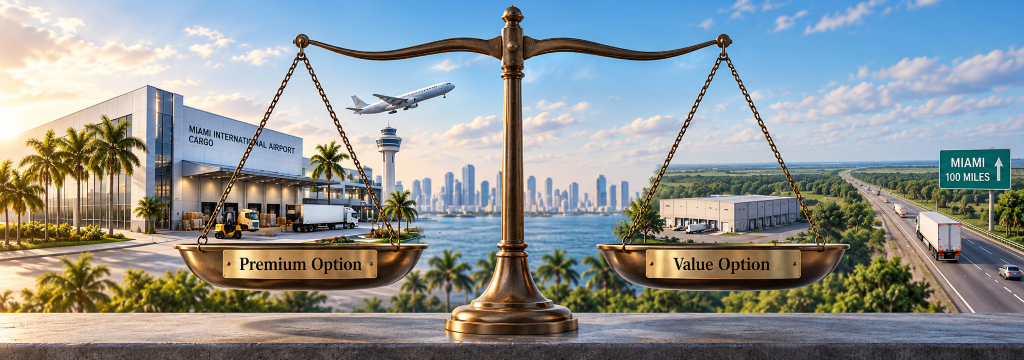
Warehouse tenants looking in Miami-Dade can often reduce their real estate costs by moving farther from Miami International Airport. On a rent comparison alone, the less expensive building may appear to be the obvious choice.
But for companies that move freight through MIA regularly, rent is only one component of occupancy cost.
The more useful calculation is whether the savings on rent outweigh the additional cost of moving trucks, drivers and goods between the warehouse and the airport day after day.
That question is becoming increasingly relevant as MIA handles unprecedented freight volumes. Cargo shipments at Miami International Airport increased 13.6% in 2025 to nearly 3.5 million tons, marking the airport’s sixth consecutive record year for cargo. MIA also became the busiest U.S. airport for total freight and ranked third worldwide, behind Hong Kong and Shanghai.
For logistics-intensive businesses, proximity to that activity can have measurable value.
Start With the Rent Difference — But Don’t Stop There
Suppose a company is considering two comparable warehouses: one in the Airport/Doral area and another location farther from MIA.
The farther property may carry a lower annual rental obligation. That savings is easy to quantify.
What can be harder to see are the operating costs created by the additional distance.
For a business making frequent airport runs, even a modest increase in travel time can multiply quickly across hundreds or thousands of trips each year. The calculation can include:
- Driver wages and overtime
- Fuel consumption
- Vehicle maintenance and depreciation
- Toll expenses
- Additional trucks or drivers needed to maintain the same throughput
- Time lost to traffic congestion
- Reduced scheduling flexibility
- Increased risk of missing cargo cutoff or delivery windows
A building that saves money on rent but adds substantial transportation expense may ultimately be the more expensive facility to operate.
Frequency Changes the Equation
The value of being close to MIA depends heavily on how often a company actually interacts with the airport.
A tenant receiving a few airport shipments per month may have little reason to pay a significant location premium.
The economics can look very different for a freight forwarder, importer, exporter, perishables distributor, pharmaceutical company or e-commerce operation dispatching trucks to and from MIA multiple times a day.
Consider a company making eight airport-related truck trips each business day. If moving farther from MIA adds just 30 minutes to each round trip, that represents four additional driver-hours per day.
Over roughly 250 operating days, that becomes approximately 1,000 additional driver-hours annually — before accounting for fuel, maintenance, tolls or delays.
That doesn’t automatically make the airport location the better choice. It does illustrate why evaluating the decision solely on rent per square foot can produce the wrong answer.
Reliability Has a Cost, Too
Not every logistics expense appears neatly on an operating statement.
For some businesses, predictability is nearly as important as mileage.
A warehouse close to MIA can provide greater flexibility when shipments arrive late, schedules change or freight needs to reach a terminal quickly. Reducing the number of miles that trucks must travel through Miami traffic can also reduce the number of variables affecting delivery times.
That can be particularly important for time-sensitive or high-value cargo.
MIA’s freight mix underscores the significance of those operations. The airport reports that 85% of its freight is international, and major cargo categories include perishables, pharmaceuticals, electronics, industrial machinery and medical equipment.
For businesses handling those types of products, the consequences of a missed cutoff or delayed pickup can outweigh relatively small differences in warehouse rent.
Labor Should Be Part of the Analysis
Truck travel isn’t the only labor consideration.
Longer freight cycles can affect warehouse operations as well. Employees may spend more time waiting for inbound loads, coordinating delayed deliveries or adjusting receiving and shipping schedules.
A location that allows goods to move between the airport and warehouse more quickly can potentially increase the number of turns a company achieves with the same labor and equipment.
For operations running multiple shifts or processing high volumes, those productivity differences deserve to be included in the site-selection analysis.
There Is Also a Capital Question
Additional distance can eventually require additional equipment.
If longer routes mean a truck can complete fewer trips during a shift, a growing company may ultimately need another truck, another driver or both to maintain the same service level.
At that point, what began as a real estate savings can become a transportation capital expense.
This is why sophisticated warehouse users increasingly look at total occupancy and logistics cost rather than simply comparing quoted rental rates.
Miami’s Industrial Market Gives Tenants More Choices
Miami-Dade’s industrial market has become less supply-constrained than it was several years ago. Vacancy reached 7.7% in the second quarter of 2026, even as leasing activity remained strong and asking rents averaged $17.19 per square foot NNN. Approximately 7.4 million square feet of leasing activity was recorded during the first half of the year.
CBRE also reported that most of Miami’s positive industrial absorption during the first half of 2026 occurred in higher-quality buildings, suggesting that many tenants are using the greater availability of space to improve their facilities rather than simply choosing the lowest-cost option.
That makes comparing locations on more than rent particularly important.
When Does the Premium Make Sense?
Paying more for a warehouse near MIA is most likely to be economically justified when airport-related transportation is frequent, time-sensitive or operationally critical.
The calculation becomes less compelling as the number of airport trips declines.
For each prospective location, companies can estimate:
Annual rent difference
versus
Additional driver time + fuel + tolls + vehicle costs + labor inefficiencies + potential equipment requirements associated with the more distant location.
The result provides a much more meaningful comparison than rent per square foot alone.
For some tenants, moving several miles farther away may produce substantial savings with little operational impact.
For others, the least expensive warehouse on paper may prove considerably more expensive once the trucks start moving.
The Bottom Line
Proximity to Miami International Airport is not inherently worth paying a premium for.
It has value when that proximity reduces an operating expense.
With MIA now handling nearly 3.5 million tons of cargo annually, businesses that depend heavily on the airport should consider warehouse location as part of their transportation strategy—not simply as a real estate decision.
Before choosing between two facilities, the better question may not be, “How much is the rent?”
It may be, “What will this location cost us to operate from every day?”
Source: MIA Newsroom