
A Growing Gap Between Industrial Rents And Construction Costs Could Reshape Warehouse Development
November 18, 2026
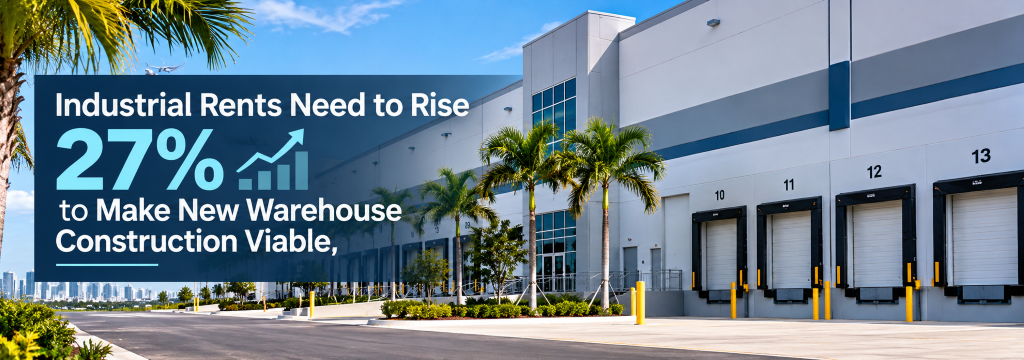
Prologis, one of the world’s largest logistics real estate owners and developers, estimates that industrial rental rates would need to increase approximately 27% above current market levels to make most new warehouse construction financially viable. The finding, outlined by Prologis Research and discussed during the company’s third-quarter 2026 earnings call, highlights the growing challenges facing industrial developers nationwide as construction expenses, financing costs and investment return requirements continue to rise.
Globest+1
Development Costs Are Outpacing Industrial Rents
The economics of industrial construction have become increasingly difficult as developers face higher borrowing costs and elevated expenses for building new warehouse and distribution facilities.
According to Prologis, the difference between today’s prevailing industrial rents and the rental income required to support new development has widened considerably.
This imbalance is particularly significant for speculative projects, which are constructed without tenants committed in advance.
Although certain markets and building sizes may still support development, the broader national picture suggests that many proposed industrial projects will remain financially unattractive until rental rates increase or development costs decline.
Industrial Demand Shows Signs of Improvement
Despite the challenges facing developers, industrial leasing fundamentals have strengthened.
Prologis reported approximately 63 million square feet of logistics net absorption during the third quarter of 2026, while vacancy declined by 10 basis points. Industrial market rents increased 1.5% during the first nine months of the year.
Demand is also becoming more diversified. In addition to traditional distribution and logistics companies, industrial properties are attracting interest from advanced manufacturers and businesses supporting data center development.
These emerging sources of demand could help absorb existing warehouse inventory while contributing to a gradual recovery in rental rates.
Yahoo Finance+1
Limited New Construction Could Benefit Existing Properties
With the financial feasibility of speculative industrial development under pressure, fewer new projects may enter the construction pipeline.
For owners of existing warehouse and distribution properties, a slowdown in new supply could eventually provide a competitive advantage, particularly in established industrial locations where suitable development sites are limited.
Prologis anticipates declining vacancy and improving rental rates in 2027 as demand strengthens and the availability of desirable industrial space becomes more constrained.
However, the company continues to pursue development opportunities, particularly build-to-suit facilities constructed for identified tenants. Its build-to-suit pipeline was approximately 20% to 25% larger than a year earlier, reflecting continued demand for specialized logistics facilities.
Commercial Observer+1
Implications for Miami Airport and South Florida Industrial Markets
The findings carry potential implications for the industrial markets surrounding Miami International Airport, including Doral, Medley, Airport West and Hialeah.
These established distribution and logistics submarkets serve businesses that rely on proximity to air cargo operations, major transportation corridors and South Florida’s population centers.
For industrial property owners, a prolonged reduction in new construction could eventually support leasing activity and rental rates as available inventory is absorbed.
For tenants, particularly companies requiring specialized facilities or strategic airport access, the availability of existing warehouse properties may become increasingly important if new development remains economically challenging.
However, Prologis’ 27% figure represents a national estimate rather than a specific rental-growth forecast for Miami. Local conditions, including vacancy, tenant demand and competing inventory, will ultimately determine how quickly the market responds.
The broader takeaway for Miami-area industrial real estate is that the cost of replacing existing warehouse space may become an increasingly important consideration in property valuations, leasing negotiations and future development decisions.
Source: GlobeSt.