
Warehouse Automation Is Turning Modern Logistics Space Into A Hot Commodity
April 1, 2026
Early forecasts suggested automation would reduce the need for warehouse space, but newer data shows the opposite: it is strengthening long-term demand for modern logistics real estate, according to Prologis research.
By 2025, about 30% of modern logistics facilities are expected to include some level of automation, up from roughly 20–25% five years ago. Built-to-suit developments designed with automation now make up around 40% of new projects. Major North American retailers that have adopted automation have increased their market share by more than 700 basis points between 2019 and 2025. At the same time, warehouse space per unit sold has remained stable or even grown, highlighting automation as a key competitive advantage in supply chains.
Automation in warehouses takes several forms. Fully automated facilities—where storage, retrieval, and internal transport are handled entirely by machines—typically rely on fixed AS/RS systems using cranes, shuttles, or lifts. These buildings require specialized features such as clear heights of at least 32 feet, flat floors, and wide column spacing. However, adoption remains limited, with only about 3–5% of warehouses fully automated.
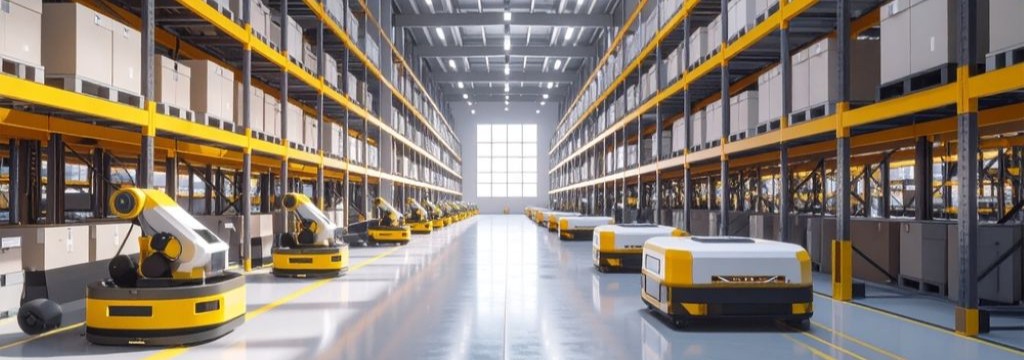
More common is partial automation, where technology supports specific tasks while workers continue core operations. Autonomous mobile robots and automated guided vehicles are used in roughly 10–15% of facilities, improving speed and flexibility in standard warehouses with clear heights of 25–35 feet. Other technologies include fixed conveyor or sortation systems, found in 7–9% of warehouses, and robotic picking systems, used in about 4–5%.
Businesses are increasingly adopting automation to address labor shortages, handle more complex supply chains, and make better use of existing space. Modular, flexible systems are gaining traction quickly because they cost about one-third as much as fully automated AS/RS setups, while fully automated solutions remain less common due to their high cost and strict building requirements.
The impact on logistics real estate is significant. Automation enhances service levels, supports broader distribution networks, and enables higher output even in older or urban warehouses. Automated facilities tend to achieve higher rents, longer lease terms, and better tenant retention, increasing their value for both operators and property owners. In fact, nearly 10% of new leases are now signed specifically to enable automation.
Looking ahead, Prologis expects that by 2035, up to half of all modern warehouses could incorporate some form of automation, with flexible systems leading the way.
Source: GlobeSt