
Inside The Industrial Boom Bringing Millions Of People To The South

June 17, 2026
When asked whether JCB would ever open a factory in California, Ken Bianco laughs.
“Absolutely not,” says the vice president of commercial operations for JCB, dismissing the idea with a wave of his hand. Although many of the company’s customers are based there, Bianco argues that California has become too slow and cumbersome for businesses. “Everything takes too long,” he says. “It’s simply not business-friendly.”
Standing in the lobby of JCB’s North American headquarters in Georgia, Bianco points to the company’s growth story. Founded in Britain in 1945, the construction equipment manufacturer chose the American South when establishing its first U.S. facility in 2001. Georgia, he recalls, offered attractive incentives and a welcoming business environment. Today, the company operates more than 500,000 square feet of manufacturing space in the state and is building another major facility in Texas.
Madison Hoff/WELT/BI)
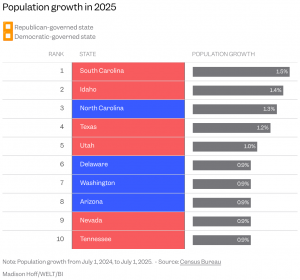
JCB’s experience reflects a broader trend reshaping the American economy. Republican-led states across the South and Mountain West are attracting businesses, investment, and people at a remarkable pace. States such as Georgia, Florida, South Carolina, Texas, and Utah ranked among the nation’s strongest performers in both economic and population growth during 2025.
While the U.S. economy expanded by just over 2% last year, several Southern states outperformed the national average. Florida and South Carolina led the country in economic growth, while Texas and Utah also posted strong gains. At the same time, millions of Americans have relocated to these states, drawn by lower taxes, affordable housing, and expanding job opportunities.
The shift marks a significant change in America’s economic geography. Traditional powerhouses such as New York, California, Boston, and San Francisco remain dominant centers for finance, technology, and research. Yet manufacturing investment is increasingly flowing elsewhere. According to commercial real estate data, hundreds of companies have relocated their headquarters in recent years, many moving from high-tax states such as California and New York to states like Texas and Florida.
Population trends tell a similar story. California has experienced years of net outmigration, while New York’s population growth has largely stalled. In contrast, South Carolina has become one of the fastest-growing states in the country, and Texas has added millions of new residents over the past decade and a half. Florida continues to attract both domestic migrants and international newcomers, while Utah benefits from a young and expanding workforce.
These demographic shifts are the result of millions of individual decisions, but together they point to a broader pattern: Republican-governed states are increasingly attracting both people and capital. Examples can be found across the country. Billionaire investor Kenneth Griffin has publicly praised Miami as a more attractive destination for investment than New York. Technology workers have left Silicon Valley for Austin, seeking lower taxes and a better quality of life. Retirees continue to move south in large numbers, particularly to Florida.
Industrial growth has been especially important. Near Savannah, Georgia, JCB now produces more than twenty excavators each day and plans to expand further as demand grows. The company employs hundreds of workers and has benefited not only from construction demand but also from increased spending on defense-related equipment.
For many businesses, the appeal of the South is straightforward. State governments often emphasize lower taxes, lighter regulation, and faster permitting processes. Projects that might face years of delays elsewhere can often move forward more quickly. Local governments frequently compete to attract investment, offering incentives and streamlined approvals.
Texas provides perhaps the clearest example. The state has become a magnet for both energy and technology companies. Oil and gas producers have benefited from a more favorable regulatory climate, while technology firms continue to expand around Austin, Dallas, and Houston. Elon Musk has moved major operations there, building a network of facilities for companies including SpaceX, Tesla, X, and The Boring Company.
Although cities such as Austin have become more expensive and now face challenges including housing shortages and traffic congestion, they remain more affordable than many coastal metropolitan areas. Lower taxes and greater housing availability continue to attract workers and businesses alike.
The investment boom is also visible in the region’s construction activity. New suburban developments, logistics hubs, warehouses, and industrial parks are appearing around cities such as Houston, Atlanta, Miami, Savannah, and Laredo. At the same time, data-center construction has accelerated as operators seek cheaper land, lower energy costs, and more predictable permitting environments.
Another factor influencing corporate decisions is logistics and supply-chain reliability. Some companies that once relied heavily on West Coast ports are increasingly shifting cargo through Atlantic and Gulf Coast gateways such as Savannah. While shipping routes may be longer, businesses often cite operational efficiency and security considerations as advantages.
Labor relations also play a role. Union membership rates tend to be lower across much of the South than in many coastal states, a factor that can influence location decisions for manufacturers and logistics operators.
The region’s growth extends beyond traditional industries. Utah’s “Silicon Slopes” has emerged as a technology hub, attracting software firms and startups seeking lower costs than California. Meanwhile, states such as Georgia, South Carolina, and Alabama have become major centers for automotive manufacturing, drawing investments from American, European, and Asian companies.
German automakers offer a notable example. While Europe’s automotive sector faces significant challenges, the United States remains an attractive growth market. Companies such as Mercedes-Benz and BMW continue to invest billions of dollars in Southern manufacturing facilities, reinforcing the region’s position as one of the world’s most important industrial corridors.
California and New York remain economic giants, powered by technology, finance, and entertainment. Yet the strongest momentum in manufacturing, logistics, population growth, and industrial investment increasingly belongs to the Republican-led states of the South and Mountain West. As businesses continue to search for lower costs, faster approvals, and access to growing workforces, the region’s economic rise shows few signs of slowing.
Source: Business Insider