
Major Projects Underway At PortMiami
April 13, 2026
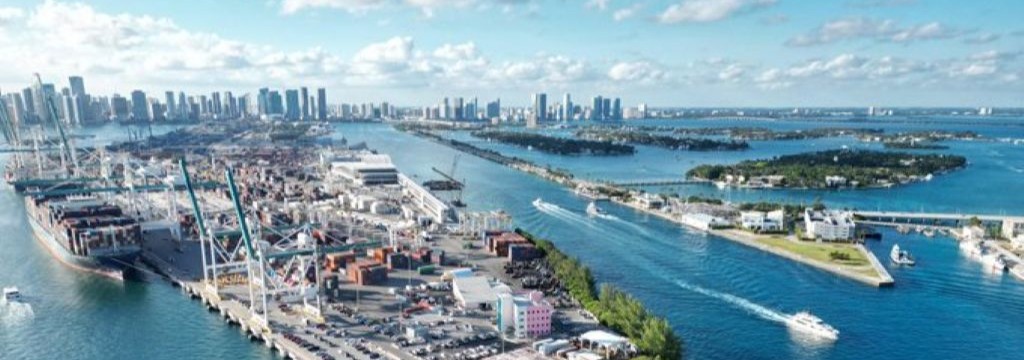
PortMiami is in the midst of significant upgrades and expansions across both its cargo and cruise operations.
Key initiatives include the construction of new cruise terminals, the addition of a third berth at MSC Cruises’ Terminal AA, the purchase of additional ship-to-shore cranes, and the completion of the second phase of its electric rubber-tire gantry (eRTG) crane program.
Over the past five years, the port has secured more than $97 million in combined state and federal funding to support its Capital Improvement Program. This includes $19.5 million from the Florida Department of Environmental Protection for Berth 10 and nearly $22 million from the Florida Department of Transportation and the U.S. Environmental Protection Agency for its shore power program, launched in June 2024.
The shore power system allows docked cruise ships to shut down their engines and connect to the local electrical grid, significantly reducing emissions. PortMiami is currently the only seaport in Florida—and one of just two on the entire East Coast—to offer this capability.
A major upcoming project is the construction of Berth 10 on the east end of the port, expected to be completed by fall 2028. This berth will serve as the third docking space for the new MSC cruise terminal, which opened in April 2025. Designed in an “airport-style” model, the terminal can accommodate up to three vessels from multiple cruise lines simultaneously—an evolution from the traditional one-ship-per-terminal approach. In addition, PortMiami will begin a seven-year North Bulkhead reconstruction project in 2027, replacing six cruise berths one at a time each summer.
The port has already developed five new large-scale cruise terminals in recent years and continues expanding. A new Terminal G, currently under construction for Royal Caribbean and Celebrity Cruises, will handle next-generation ships with capacities of up to 7,000 passengers and is scheduled for completion in December 2027.
On the cargo side, PortMiami plans to expand its fleet of ship-to-shore gantry cranes beyond its current 13 electric units. It is also completing the second phase of its eRTG program in partnership with South Florida Container Terminal. This upgrade will allow containers to be stacked higher and moved more efficiently, increasing overall capacity on the port’s 520-acre site.
Another major development is a new cold storage and phytosanitary facility being built in collaboration with Miami International Airport. This state-of-the-art hub will use advanced technologies, including X-ray systems, to process perishable goods more efficiently. Construction began in mid-2025.
Technology and innovation remain central to PortMiami’s strategy. Through a partnership with the Miami-Dade Innovation Authority, the port is implementing AI-driven solutions to improve cargo tracking, traffic flow, and operational efficiency. Companies involved in the initiative are working on systems to monitor container movement, track truck activity, and predict congestion using computer vision.
Overall, PortMiami continues to invest heavily in infrastructure, sustainability, and technology to enhance its role as a leading global seaport.
Source: Miami Today