
Real Estate's New Center Of Gravity: Data Centers
June 24, 2026
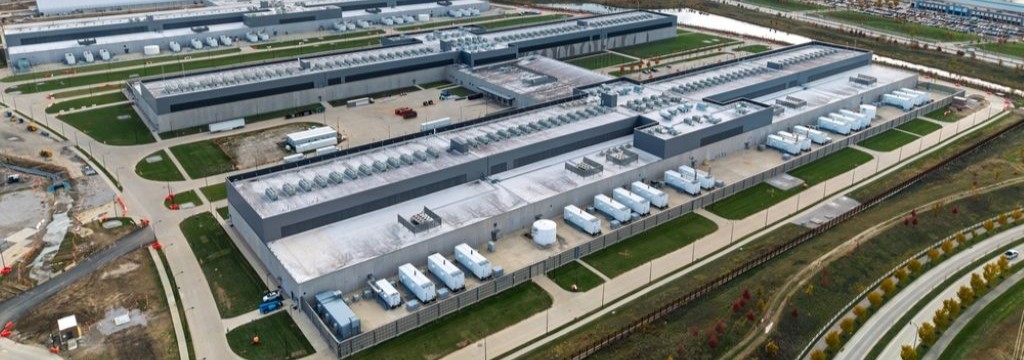
A surge of investment in data centers—driven by demand for artificial intelligence infrastructure—is rapidly reshaping commercial real estate.
Capital is increasingly concentrated in a single property type, marking one of the most focused investment cycles in decades.
For investors and policymakers, the implications are significant. The boom depends heavily on sustained AI growth, continued technological relevance, and the long-term usability of highly specialized facilities. If any of those assumptions weaken, the exposure could become uneven.
The scale of growth is striking. In the U.S., spending on data center construction now exceeds all other commercial real estate combined, according to Carlyle Research Head Jason Thomas. Since ChatGPT’s launch in late 2022, data center construction has jumped roughly 220%, while other real estate development has risen under 10%.
Capital has followed. Digital infrastructure-focused funds raised over $100 billion last year—about double the prior year—and accounted for roughly half of infrastructure fundraising, according to Preqin. Large transactions are becoming routine, including deals exceeding $10 billion and one reaching $40 billion in 2025. Debt financing has also surged, climbing from $27 billion in 2020 to $92 billion last year, per JLL.
This concentration raises a key risk: what happens if the AI-driven demand thesis slows or shifts? Some analysts warn the scale may become extreme. Thomas has suggested that data centers could eventually absorb nearly all net private capital formation, noting uncertainty around depreciation, hardware cycles, and monetization timelines. Companies are also flagging risks such as obsolescence, geographic concentration, and reliance on a small number of tenants.
Still, the market continues to expand. MSCI estimates institutional exposure to data centers reached $122 billion across private funds as of Q3, spanning infrastructure, real estate, and private equity strategies. Not everyone sees overheating. Some practitioners argue capital availability remains strong overall, and that lenders are not starving other real estate sectors. New investors—including sovereign wealth funds—are entering the space, drawn by its perceived stability and long-term contracts. But experienced operators caution that newcomers often underestimate how fast and capital-intensive development cycles are.
Concerns about overbuilding are also emerging. Analysts compare the current wave to past real estate cycles, such as retail mall expansion, where assumptions of perpetual demand later proved wrong. Data centers, being highly specialized, may also be difficult to repurpose if conditions change. Meanwhile, the build-out continues at scale. The U.S. currently has more than 110 million square feet of data centers under construction, compared with about 67 million square feet of office space. Investment in power and communications infrastructure has now surpassed commercial property investment in recent data.
The shift is also reshaping real estate allocation. Office exposure in REIT portfolios has fallen sharply since 2020, while data center allocations have risen from under 6% to nearly 19%. Some investors, however, see opportunity in the imbalance. Reduced competition in traditional sectors like housing, industrial, and office may create attractive entry points as construction slows. But others caution that demand certainty in those areas is lower and timelines are longer.
Despite debate, momentum in data centers remains strong. Estimates suggest tens of thousands of acres of powered land will be needed globally in the coming years, and most institutional investors plan to increase exposure. The core question going forward is not whether demand is strong today, but whether it remains durable—and how flexible these assets will be if the cycle turns. For now, capital is crowded into the trade. The opportunity, for some investors, may lie in what comes after it.
Source: CoStar