
How Significant Is The Backlash Against Data Centers?
May 25, 2026
There’s a growing pushback against AI-driven data center development across the U.S. as local, state and federal officials grapple with concerns raised by residents about potential electricity rate increases, water shortages, expensive tax breaks, noise and air pollution problems.
The backlash has resulted in a wave of enacted and proposed building moratoriums and policy changes.
“The pushback is a pretty recent phenomenon,” said Sean Farney, JLL’s vice president of data center strategy for the Americas. “There may be some fear, uncertainty and doubt around AI and perhaps this negative perception that AI will take jobs away, when the opposite is true.”
Farney and others say there are misperceptions and misinformation surrounding data centers, particularly regarding impacts on electricity rates and water usage. Many officials say that is why they need more time to research how data centers will affect their communities.
On a federal level, Sen. Bernie Sanders and Rep. Alexandria Ocasio-Cortez introduced the Artificial Intelligence Data Center Moratorium Act in March that would stop new construction or upgrades to data centers with power demand of 20 megawatts or more. The bill calls for requirements to protect residential ratepayers and the environment. It would give communities the right to decide on projects and curtail government subsidies. Earlier that month, major tech companies including Amazon, Google, Meta, Microsoft, Oracle and OpenAI signed a “Ratepayer Protection Pledge” at the White House, stating they would pay their own power and grid integration costs.
More than 300 data center-related bills were proposed in over 30 states this year. At least 14 states considered data center moratoriums: Georgia, Maine, Maryland, Michigan, Minnesota, New Hampshire, New York, Oklahoma, Pennsylvania, South Carolina, South Dakota, Vermont, Virginia and Wisconsin, according to the National Conference of State Legislatures.
Maine was set to become the first state to enact a temporary ban after the legislature agreed to an 18-month moratorium on data centers over 20 megawatts. But Gov. Janet Mills vetoed the bill because it didn’t provide an exception for a facility at a shuttered paper mill. She argued it would create more than 800 construction jobs and 100 high-paying permanent jobs while contributing substantial property tax revenue.
Voters in Ohio, home to about 200 data centers, may see a proposed ban on the November ballot if enough signatures are collected by July 1. The amendment would prohibit data centers requiring 25 megawatts or more.
After considering a statewide moratorium, South Dakota approved a bill allowing local governments to ban or regulate data centers. It includes residential ratepayer protections and requires projected water consumption data.
A proposed one-year moratorium on data center construction in New Hampshire failed to pass. In Wisconsin, at least four data center bills, including one banning non-disclosure agreements with local officials, died when no action was taken.
Dan Diorio, vice president of state policy at industry group Data Center Coalition, pushed back against statewide moratoriums, saying they would discourage further investment from both data center developers and other industries.
“It would send a signal that the state is closed for business, causing it to relinquish significant long-term economic investment, high-wage jobs and critical tax revenue to nearby areas,” Diorio said.
Local Communities Take Action
Breana Wheeler, director of operations for BREEAM USA, which creates sustainable building standards, said legislation proposing moratoriums is not simply NIMBYism.
“Data center developers need to do a better job engaging with communities and explaining how they plan to manage concerns and risks, as well as the benefits they will provide,” said Wheeler. “Even a moratorium can be interpreted as an outright ban because “in the context of speed to market, it might as well be a ban” from the industry perspective.”
That urgency has led many local communities to take action, with nearly 70 moratoriums adopted this year. On May 18, the Denver City Council adopted a moratorium to halt the construction of data centers for the next year. In April, Oakley, California, became the first Bay Area city to temporarily ban data centers while officials draft new zoning rules and study environmental impacts.
At least 20 Ohio municipalities, including Dayton and Findlay, have enacted moratoriums. The Village of Lordstown, Ohio, is being sued by the developer of a proposed $3.6 billion data center, who claims the village enacted a ban and later a moratorium after the plan was filed under current zoning rules.
In Texas, Hill County commissioners recently approved a one-year moratorium. It’s the first temporary ban in Texas and comes as data center developers increasingly target rural areas for new campuses.
So far, ballot measures have emerged in five municipalities across California, Michigan, Nevada and Wisconsin. Residents of Box Elder County, Utah, where the 40,000-acre, 9-gigawatt Stratos project from O’Leary Digital was recently approved despite local opposition, are trying to secure enough signatures to force a referendum on the hyperscale data center campus.
One measure has already been decided. In April, Port Washington, Wisconsin, became the first U.S. municipality to pass a referendum requiring voter approval for future tax incentives higher than $10 million for data center projects. The city is the site of a controversial $15 billion, 1,900-acre AI data center being built by a partnership of Vantage Data Centers, OpenAI and Oracle as part of the Stargate Project, a $500 billion AI infrastructure venture intended to power about 10 gigawatts of data center capacity.
On June 2, voters in Monterey Park, California, will decide on a data center ban. Earlier this year, the City Council enacted a 45-day moratorium in response to a proposed 49.9-megawatt data center, even though the plan was later withdrawn.
In Janesville, Wisconsin, voters will decide in November whether an $8 billion, 11-building, 800-megawatt data center proposed by Viridian Partners can be built at a former General Motors site because it exceeds the local $450 million development threshold.
Not all communities are trying to limit data center development. In Pittsburg, California, the city’s General Plan and Pittsburg Technology Specific Plan allow data center construction. AVAIO Digital Partners is building a 92-megawatt data center campus there as the $800 million first phase of its 76-acre Pittsburg Technology Park.
Arielle Harris, a partner and land-use/zoning attorney with Cox Castle in San Francisco, pointed out that local opposition does not follow political party lines.
“It’s really very specialized to the project, its location and the community. Opposition can come from any place. Whether the opposition is based on fact or not, when organized it can create regulatory uncertainty for projects seeking local zoning approvals,” Harris said. “Many jurisdictions do not specifically address data centers as a use category in their zoning codes. Each jurisdiction has to decide whether they’re going to regulate data centers in a way that’s different from other industrial uses,”
Guardrails Considered, Tax Incentives Targeted
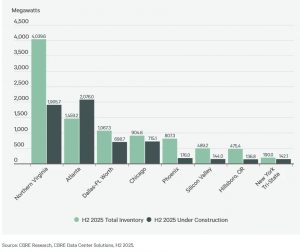
Even the states with the largest existing and planned data center footprints — Virginia and Texas — are considering or implementing new guardrails. Virginia has more than 600 data centers, mostly concentrated in Northern Virginia’s “Data Center Alley.” Texas, meanwhile, is expected to become the world’s largest data center market by 2030, according to JLL. The state’s abundant energy resources, including natural gas, ample land and business-friendly policies have fueled rapid growth.
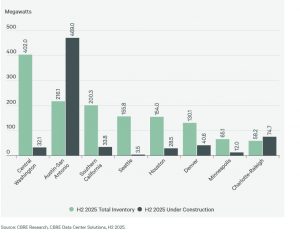
In Virginia, 61 bills were introduced this year, with 15 approved, including measures requiring high-demand users consuming 25 megawatts or more to pay for increased capacity and preventing those costs from being passed to other ratepayers. Proposals exceeding 100 megawatts will face more stringent permitting requirements, including assessments of impacts on historical sites.
That scrutiny likely stems from the Prince William Digital Gateway project, which would place 37 data centers on 1,700 acres near Manassas National Battlefield Park. After prolonged litigation, Compass Datacenters — one of the companies behind the project — withdrew after a court ruling in March voided the zoning approval. QTS is appealing the decision.
Legislation concerning tax exemptions for data centers, which costs Virginia an estimated $1.6 billion annually in lost revenue, did not receive a vote. Some proposals would eliminate the exemptions entirely or require environmental compliance to qualify for incentives.
Texas lawmakers are also considering changes to the state’s data center sales tax structure after incentives surpassed $1 billion and could exceed $3 billion in lost revenue by 2029.
Last June, the Texas Legislature approved Senate Bill 6, requiring large-load customers using 75 megawatts or more within the ERCOT region to pay the full costs of grid interconnections so residential customers would not absorb expenses tied to new power lines, substations and transmission upgrades. Under other provisions of SB6, data center developers must disclose whether projects have backup generation capacity equal to at least 50 percent of site demand and may be required to use it during ERCOT emergencies.
“SB6 strikes a balance between supporting growth and maintaining grid stability,” said Jason Jennaro, CEO of FrontierGen, an infrastructure development platform delivering data center campuses in Texas. “It puts more responsibility on developers to not socialize their capital costs onto ratepayers, and we think that is completely appropriate. We want development in Texas, but it shouldn’t be subsidized by the Texas ratepayer.”
Source: Commercial Property Executive